Home Battery Installation Rules: Permits, Panels, Clearances, and Safety Checks
What problem does this solve?
Home Battery Installation Rules: Permits, Panels, Clearances, and Safety Checks answers a practical homeowner question: How should I install a home battery installation safely for home backup? The useful answer is not a brand claim or a single capacity number. It is a decision path that connects loads, runtime, safety, installation scope, and future service.
This draft came from the home battery CSV schedule batch, sequence 22. It consolidates related keyword variants such as home battery installation, home battery installation rules so the site publishes one useful page instead of several thin pages.
Short answer
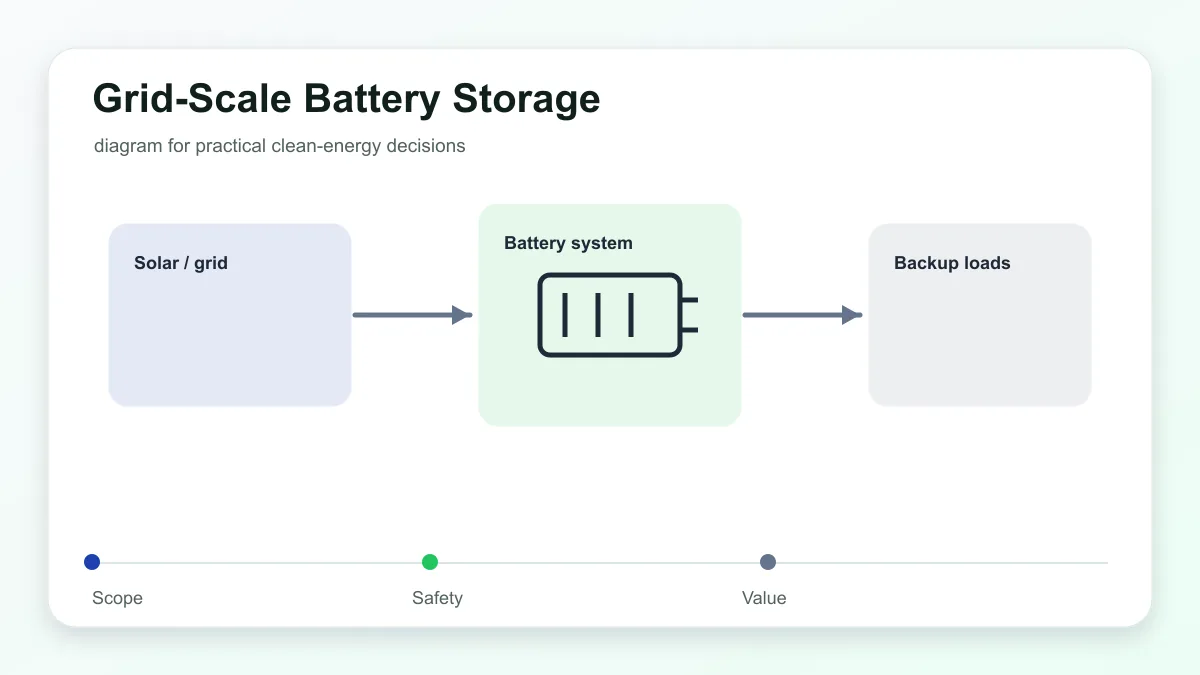
Treat installation as a system design problem. Battery, inverter, panel, transfer equipment, disconnects, and backed-up circuits must be compatible before a quote is accepted.
Inputs to collect before choosing
- site check
- mounting or wiring requirement
- permit trigger
- service access
- safety boundary
Write those numbers down before comparing quotes. A home battery decision becomes weak when the homeowner starts with a product name and works backward. Start with the job, then choose the system.
Simple calculation framework
battery kWh needed = critical load watts x hours / 1000 / usable fraction
For example, 1,000 watts for 10 hours is 10 kWh before reserve and losses. If only 80 percent is usable, the installed battery needs more nameplate capacity.
Use useful capacity, not nameplate capacity. A battery sold as 13.5 kWh may not make the full number available after reserve settings, temperature limits, inverter losses, and age. The quote should state both nameplate and usable capacity.
Match the answer to the homeowner scenario
- Critical-load backup: define the exact circuits that must stay on, then size kWh and kW around those circuits.
- Whole-home backup: separate normal comfort loads from emergency loads. HVAC, pumps, ovens, dryers, and EV charging can quickly exceed inverter limits.
- Solar storage: check whether daytime solar can refill the battery during an outage and whether seasonal sun hours make the plan realistic.
- Time-of-use shifting: calculate savings from real tariffs and usage patterns before treating the battery as a financial product.
The same battery can be a good fit in one home and a weak fit in another. A homeowner with short evening outages, a small refrigerator load, and solar surplus has a different problem from a homeowner trying to run heat pumps, a well pump, and an induction range through a multi-day storm. The page should therefore make the decision explicit instead of treating every query as a product-shopping query.
Worked example
Assume the critical loads total 1,200 watts when running and the target is 8 hours. The raw energy need is 9.6 kWh. If only 80 percent of the battery is usable, the installed battery needs at least 12 kWh before age and weather margin. The inverter must also support the simultaneous 1.2 kW load plus any surge loads from pumps, compressors, or motors.
The example is deliberately simple because the purpose is to expose the assumptions. A real design should also account for startup surge, temperature derating, battery reserve, round-trip losses, expected aging, and which circuits are actually backed up. If the homeowner cannot see those assumptions in the quote, the backup-hour claim is not yet comparable.
Decision table
| Scenario | Better content action | Why |
|---|---|---|
| Small outage loads | Size from critical loads | Avoids buying unused capacity |
| Whole-home backup | Check kW and kWh together | Large loads can exceed inverter output |
| Solar self-consumption | Model daily surplus | Battery value depends on charge source |
| Time-of-use rates | Compare annual savings | A battery can shift cost, not create energy |
Quote review checklist
- Nameplate kWh and useful kWh are both stated.
- Continuous kW, peak kW, and surge assumptions are stated.
- Backed-up circuits or whole-home backup scope is written clearly.
- Inverter, gateway, transfer equipment, disconnects, permits, labor, and commissioning are included or explicitly excluded.
- Warranty length, throughput limits, service contact, and replacement process are visible.
- Mounting surface, clearance, working space, and indoor/outdoor rating are documented.
- Utility approval, inspection, labeling, and emergency shutdown steps are assigned to a responsible party.
A quote that hides installation scope can look cheaper while being more expensive after panel work, gateway equipment, permitting, trenching, structural mounting, or service upgrades are added. A quote that states only nameplate capacity also prevents a fair comparison because two systems with the same advertised kWh can deliver different useful backup hours.
Safety and installation boundaries
Home batteries sit at the intersection of electrical work, fire safety, utility rules, warranty support, and homeowner expectations. The safe boundary is simple: do not treat a battery cabinet like a plug-in appliance when it connects to a panel, inverter, transfer equipment, or backed-up loads.
Ask the installer to document disconnects, clearances, ventilation or thermal limits, working space, critical-load selection, commissioning tests, and emergency shutdown steps. If the system can back up the home during an outage, the design must prevent unsafe backfeed to the grid.
Operation, maintenance, and replacement boundary
After commissioning, the homeowner should test outage behavior, review reserve settings, keep the installation area clear, watch for temperature or fault alerts, and document service contacts. Replacement planning should be based on usable capacity, warranty terms, and whether the original system can be expanded or must be replaced as a matched set.
Common mistakes
- skipping electrical or mounting checks
- placing equipment where it cannot be serviced
- missing permit or inspection triggers
Before install day, confirm the battery location, wall or floor support, panel capacity, backed-up circuits, utility approval path, emergency shutdown label, warranty registration, and who handles service after commissioning.
How this should link inside EcoPower.Wiki
This page should link upward to the home battery and energy storage hubs, sideways to solar storage and backup-load pages, and downward to any calculator or checklist page that solves a narrower step. That keeps the entity dictionary as the semantic base while this page handles the concrete human problem.
Related internal context:
- Home Battery Storage Costs and Benefits
- Home Battery Storage Comparison
- Home Battery Installation Cost Breakdown
- Battery Storage Safety Guide
Practical recommendation
Choose the smallest home battery setup that reliably covers the job after usable-capacity, output, installation, and service constraints are accounted for. If two quotes look similar, favor the one with clearer scope, safer documentation, and better local support.
FAQ
Is home battery installation rules: permits, panels, clearances, and safety checks mainly a buying question?
Only partly. The better answer starts with the homeowner's load, runtime, location, safety, and service constraints, then uses those constraints to judge products or quotes.
Can one battery back up an entire home?
Sometimes, but whole-home backup depends on both capacity and output. Large electric loads may need load management, a larger inverter, or a critical-load design.
What should stop the project?
Stop when the quote does not state useful capacity, backed-up circuits, installation scope, safety responsibilities, or service path. Those gaps usually mean the decision is not ready.
References
Related Articles